1.1 Physical Quantities: Derived quantities
Derived quantities
Derived quantity MEMORISE
A physical quantity that consists of a combination of base quantities by multiplication, division or both.
| Derived quantity | Formula | Base units | Named unit |
|---|---|---|---|
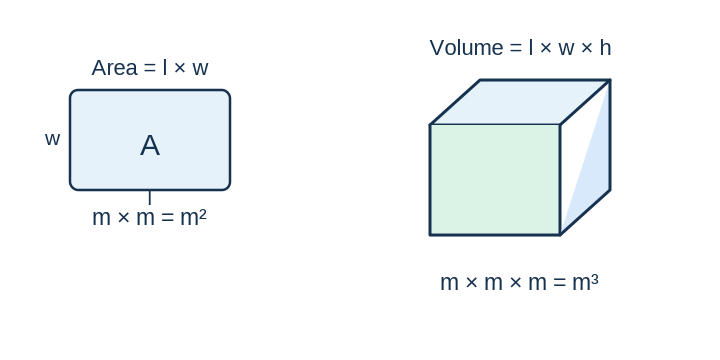
| Area, A | l × w | m² | — |
| Volume, V | l × w × h | m³ | — |
| Density, ρ | m ÷ V | kg m⁻³ | — |
| Velocity, v | s ÷ t | m s⁻¹ | — |
| Acceleration, a | Δv ÷ t | m s⁻² | — |
| Momentum, p | m × v | kg m s⁻¹ | — |
| Force, F | m × a | kg m s⁻² | newton (N) |
| Work, W | F × s | kg m² s⁻² | joule (J) |
| Power, P | W ÷ t | kg m² s⁻³ | watt (W) |
| Pressure, P | F ÷ A | kg m⁻¹ s⁻² | pascal (Pa) |
| Charge, Q | I × t | A s | coulomb (C) |
To find a unit, write the formula. Then put in the base units.
Example — unit of pressure
Write the unit of pressure, P = F ÷ A, in base units.
0 / 3 steps
Example — a number has no unit
Write the unit of kinetic energy, E = ½mv², in base units.
0 / 3 steps
Exam tip: Write m s⁻¹ with a space. "ms" means millisecond.