5.1 Fundamentals of Waves: Oscillation and waves
Oscillation and waves
A wave transfers energy without transferring matter overall. Particles oscillate about their equilibrium positions.
λ = 4 cm
v = fλ = 2 × 4 = 8 cm s⁻¹
one particle
Amplitude, A3 cm
Frequency, f2 Hz
| Quantity or condition | Relationship or meaning |
|---|---|
| Amplitude, A | Maximum displacement from equilibrium, in m |
| Period, T | Time for one complete oscillation, in s |
| Frequency, f | Oscillations per second, in Hz; f = 1/T |
| Wavelength, λ | Distance between consecutive points in phase, in m |
| Wave speed | v = fλ |
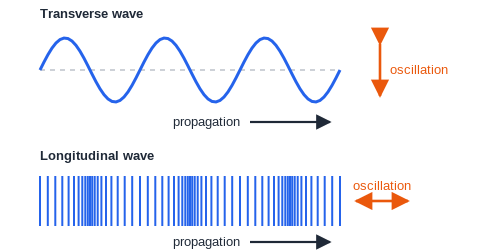
| Transverse wave | Oscillation perpendicular to propagation |
| Longitudinal wave | Oscillation parallel to propagation |
Exam tip: Read wavelength from a distance graph and period from a time graph.