Which of the following is true about gravitational field strength?
Medium
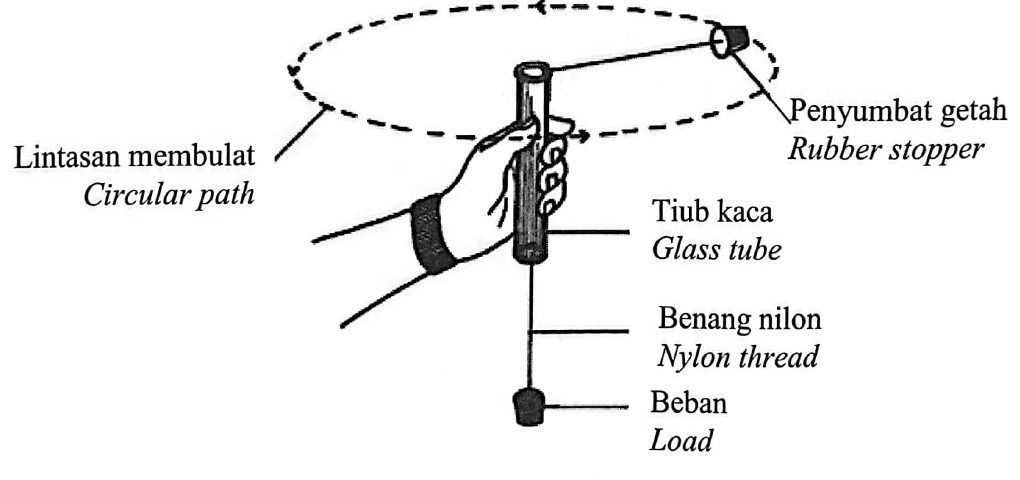
Diagram 5 shows a rubber stopper is spinned in a circular path at a constant speed (a rubber stopper on a nylon thread through a glass tube, with a load at the bottom). What will happen to the tension in thread, T when the rubber stopper is spinned with a higher speed?
Medium
The information given below states one law. 'The square of the orbital period of any planet is directly proportional to the cube of the radius of its orbit'. What law is explained by the above statement?
Easy
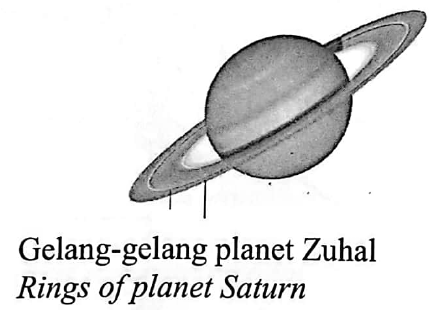
Diagram 6 shows planet Saturn with rings made up of small particles around it. Planet Saturn has a mass of 5.68 × 10²⁶ kg and radius of 6.03 × 10⁷ m. What is possibility of the small particles in the rings of planet Saturn escaping into the outer space? [Gravitational constant, G = 6.67 × 10⁻¹¹ N m² kg⁻²]
Medium
Which of the following statements is correct about the gravitational forces acting on earth and moon? [Gravitational force of the earth against the moon = F_E] [Gravitational force of the moon against the earth = F_M]
Easy
Given that the radius of the earth is R and the escape velocity on the surface of the earth is 11 km s⁻¹. What is the escape velocity at the height of 0.5R from the surface of the earth? Hint: v = √(2GM/r); v = escape velocity, G = gravitational constant, r = distance from the centre of the earth, M = mass of Earth.
Medium
According to the Newton's Universal Law of Gravitation, the force of gravity between two objects is directly proportional to
Easy
Two satellites orbiting the Earth with the same period. What is the physical quantity that is the same for both satellites?
Medium
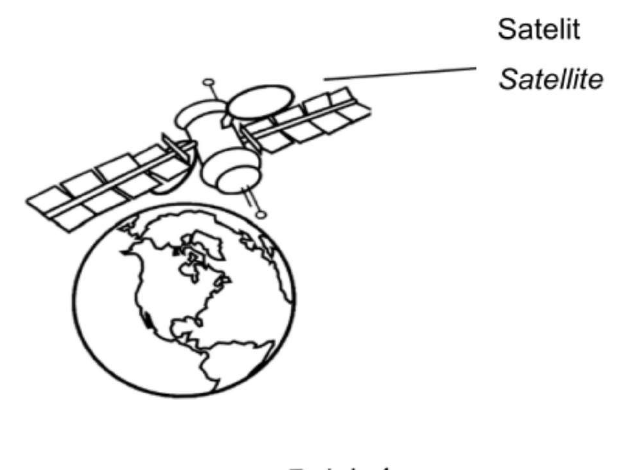
Diagram 4 shows a satellite orbiting the Earth. What is the factor that enables a satellite to maintain orbiting the Earth without falling?
Medium
Two objects A and B, masses m_A and m_B, are a distance r apart and the gravitational force is F. What happens to the force if the mass of A is doubled and the distance is halved?
Medium
Choose the statement of Kepler’s Second Law.
Easy
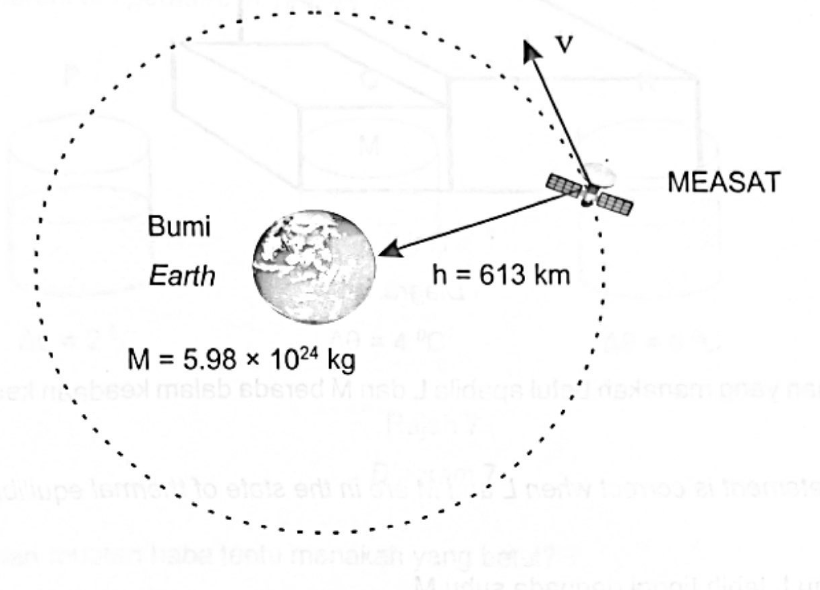
Diagram 5: Measat orbits 613 km above the Earth’s surface. Earth radius = 6.37 × 10⁶ m, Earth mass = 5.98 × 10²⁴ kg. Find the linear speed of the satellite in orbit.
Medium
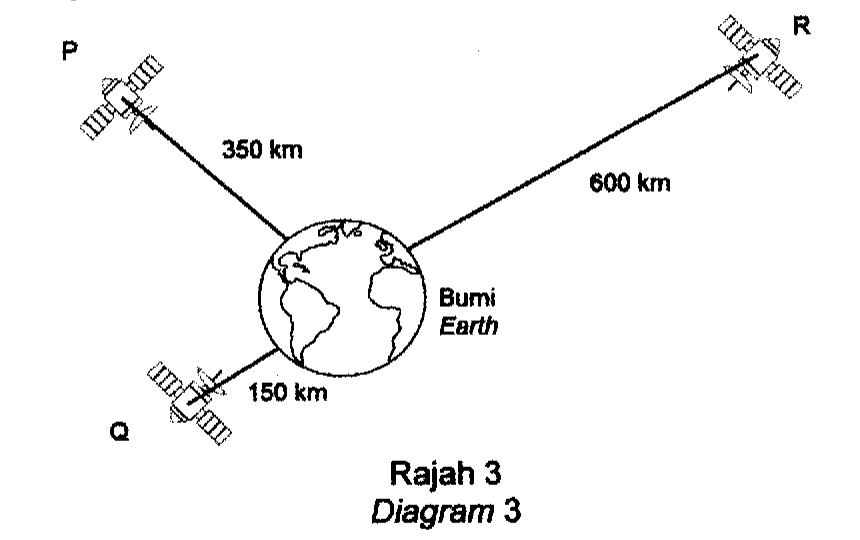
Diagram 3 shows three identical satellites P, Q and R which are located at different heights from the Earth's surface (P 350 km, Q 150 km, R 600 km). Which one shows the correct comparison of gravitational force F and acceleration due to gravity g?
Medium
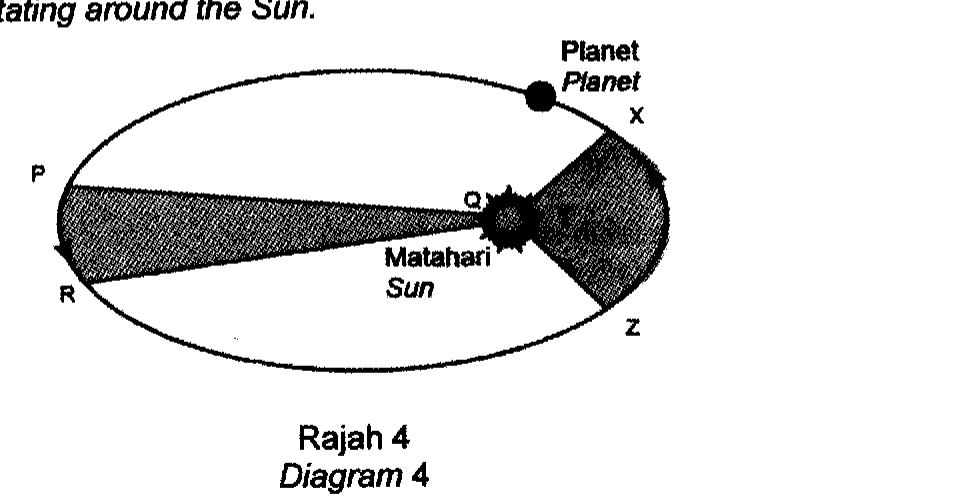
Diagram 4 shows the area covered at the same time in the regions PQR and XYZ of a planet rotating around the Sun. Which of the following is true about area of PQR and XYZ?
Medium
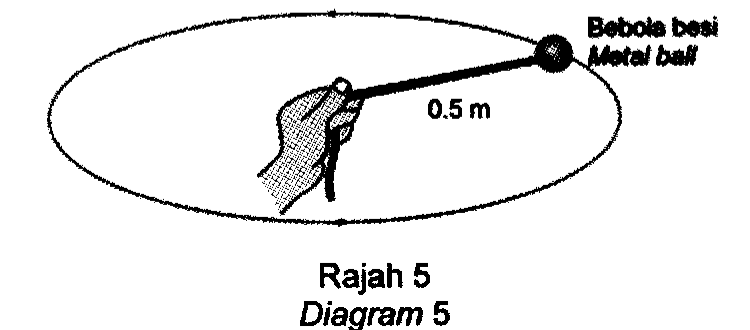
Diagram 5 shows a metal ball of mass 0.2 kg tied to the end of a string that is spun horizontally by a student. Radius of the circle is 0.5 m. If the metal ball rotates at constant speed 4 m s⁻¹, calculate the centripetal force.
Medium
Satellite J takes 20 weeks to orbit the earth. The position of satellite J is 4 times further from the earth than satellite K. How long does satellite K orbit the earth?
Medium
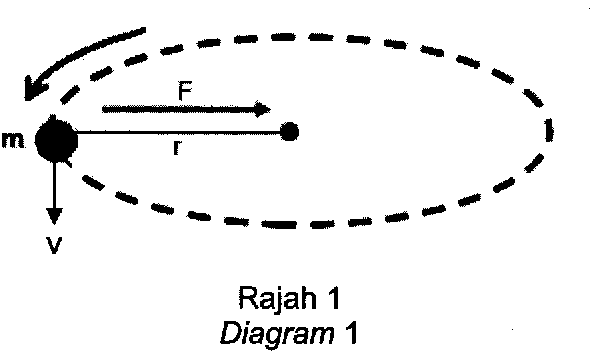
Diagram 1 shows an object of mass, m moves in a circular path of radius, r with a linear speed, v. This object experiences a centripetal force, F. Which graph shows the relationship between F and r when m and v is kept constant?
Medium
Geostationary satellites are in a special orbit known as Geostationary Earth Orbit. Which of the following statements is true about geostationary satellites?
I The orbital period is longer than 24 hours
II Being on the same place on the Earth
III Direction of motion is the same of the Earth’s rotation
IV Earth imaging satellite
Medium
A satellite is at a height, h m above the earth's surface experience gravitational acceleration, g, 8.95 m s⁻². What is height, h? [Gravitational constant, G = 6.67 × 10⁻¹¹ N m² kg⁻²] [Mass of the Earth, M = 5.97 × 10²⁴ kg] [Radius of the Earth, R = 6.37 × 10⁶ m]
Medium
'The square of orbital period of any planet is directly proportional to the cube of the radius of its orbit'. The above statement explains about
Easy
Geostationary satellites are in a special orbit known as Geostationary Earth Orbit. Which of the following statements describes about geostationary satellites?
Medium
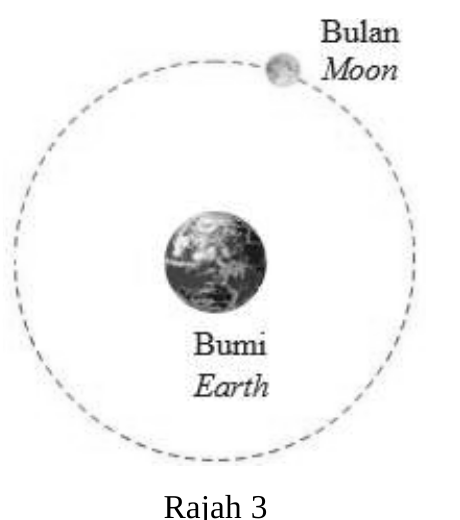
Diagram 3 shows the moon orbiting the earth. Determine the gravitational force exerted by earth on the moon. Earth mass = 5.97×10²⁴ kg, Moon mass = 7.35×10²² kg, distance between earth centre and moon centre = 3.83×10⁸ m. [G = 6.67×10⁻¹¹ N m² kg⁻²]
Medium
Which of the following is the characteristic of non-geostationary satellites?
Medium
A radar imaging satellite orbits around the Earth at a height of 480 km. What is the value of gravitational acceleration at the position of the satellite? [G = 6.67×10⁻¹¹ N m² kg⁻², M = 5.97×10²⁴ kg, R = 6.37×10⁶ m]
Medium
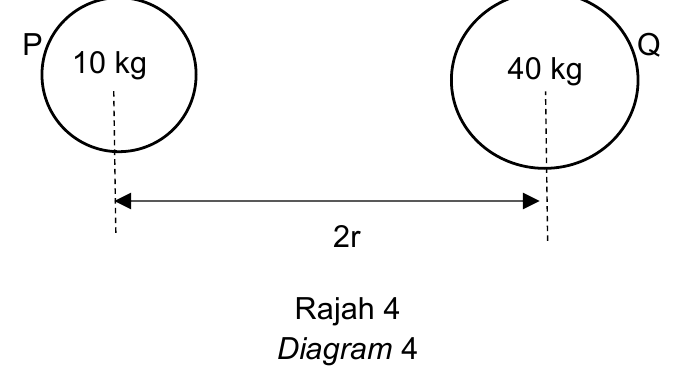
The gravitational force between two bodies, planets P (10 kg) and Q (40 kg), depends on their masses and the distance between them, 2r (Diagram 4). Based on Diagram 4, calculate the gravitational force.
Medium
A satellite orbits around the Earth with a constant period T. If R is the radius of the Earth and g is the gravitational acceleration on the surface of the Earth, which expression is the radius of the orbit?
Medium
The escape velocity at a height of 0.2R from a planet of radius R is 10 km s⁻¹. What is the escape velocity from the surface of the planet?
Medium
"The gravitational force between two objects is directly proportional to the product of the masses of the two objects and inversely proportional to the square of the distance between the centres of the two objects". The above statement refers to
Easy
R is the orbital radius of satellite S1 which orbits in period T. The value of the radius of satellite S2 which orbits in period 8T is...
Medium
Which of the following is not true about geostationary satellites?
I It moves in the same direction of the Earth's rotation
II Its period of rotation is 12 hours
III Its orbit is always above the Earth equator
IV It does not experience any gravitational pull
Medium
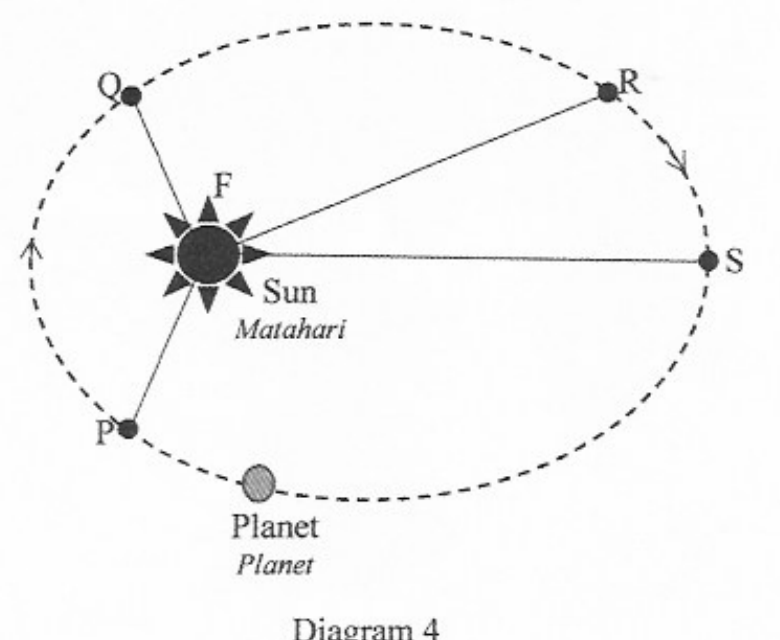
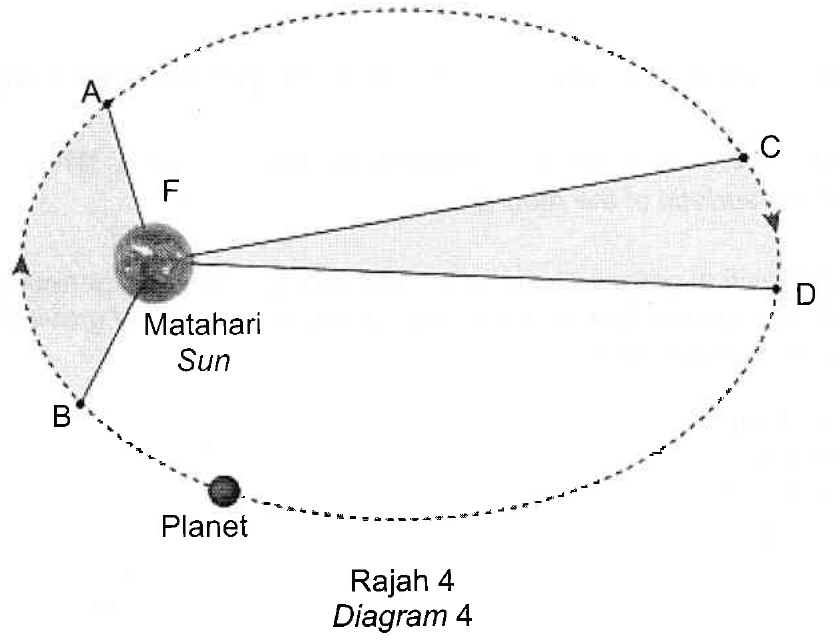
Diagram 4 shows a planet orbiting the Sun (elliptical orbit with points P, Q, R, S; sector PFQ is the area swept from P to Q and RFS from R to S, F is the Sun's position). Which statement is correct to describe movement of the planet in its orbit?
Medium
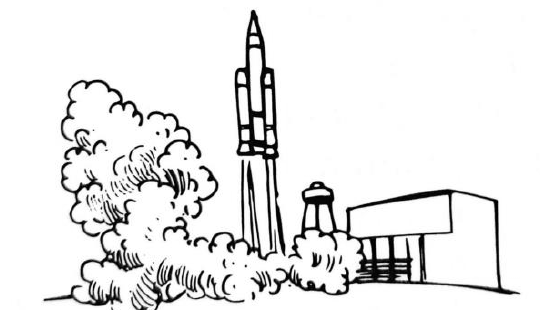
Diagram 5 shows a rocket being launched to send man-made satellites to outer space. Why does the rocket require a large amount of fuel for launching?
Medium
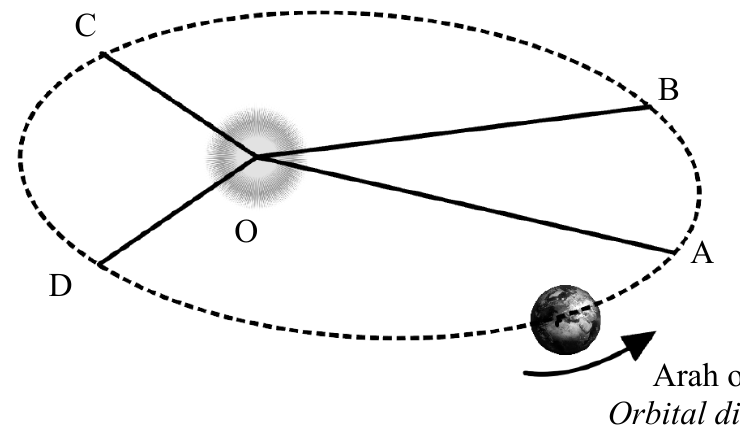
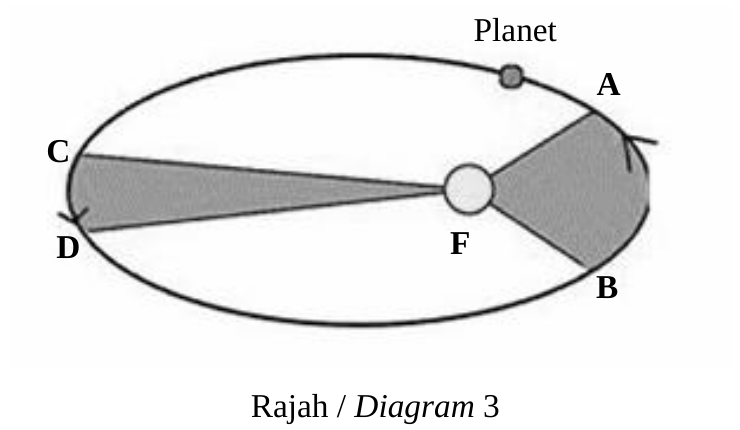
Diagram 5 shows a planet orbiting the Sun. The time taken for the planet to move from point A to point B is equal to the time taken for the planet to move from point C to point D. The statement is
Easy
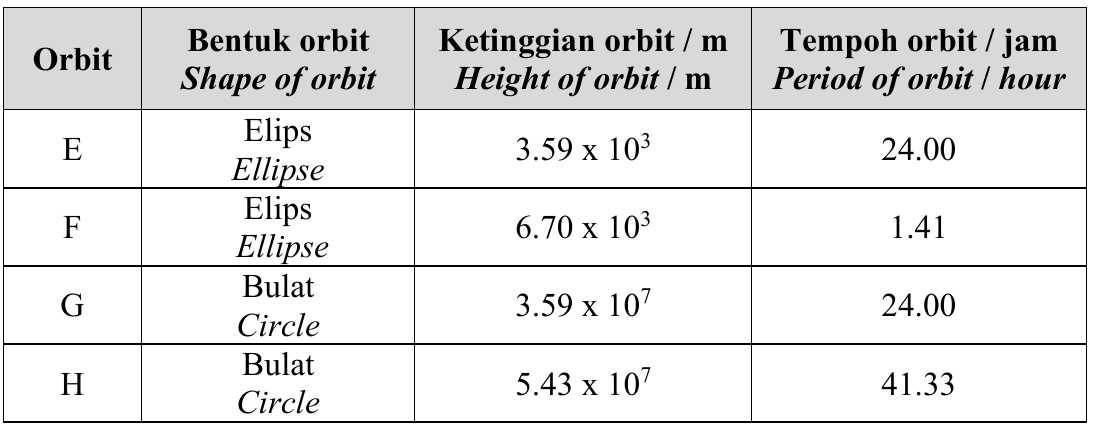
Table 1 shows information about four types of orbits E, F, G and H for satellites orbiting the earth.
Orbit | Shape | Height of orbit / m | Period / hour
E | Ellipse | 3.59 x 10^3 | 24.00
F | Ellipse | 6.70 x 10^3 | 1.41
G | Circle | 3.59 x 10^7 | 24.00
H | Circle | 5.43 x 10^7 | 41.33
Based on Table 1, determine which orbit is suitable for weather casting.
Medium
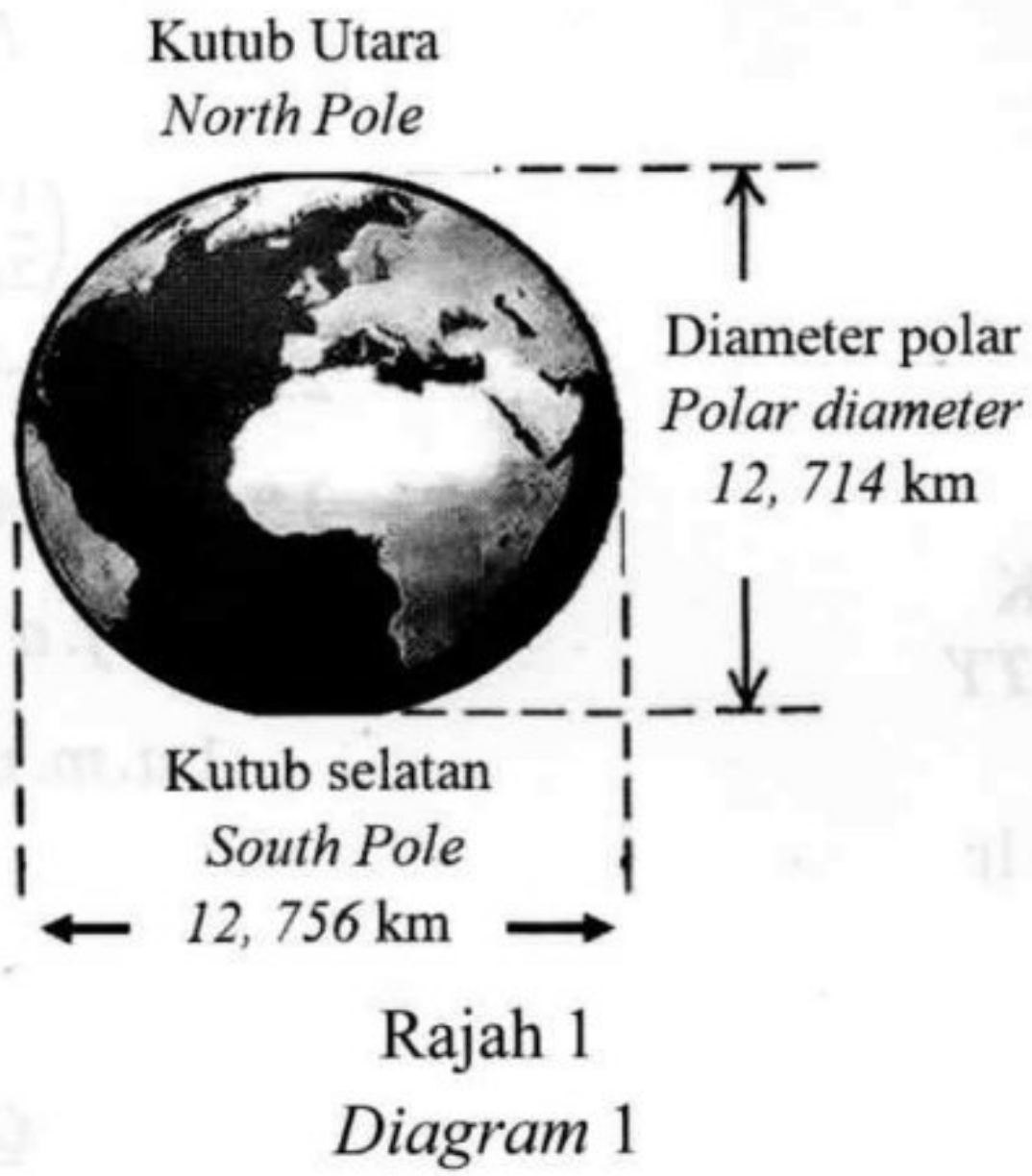
Diagram 1 shows the difference in diameter of the Earth (polar diameter 12 714 km; equatorial diameter 12 756 km). All of the following statements about gravity on the Earth are true except
Medium
The force acting per unit mass refers to
Easy
A radar imaging satellite orbits around the earth at a height of 525 km. What is the value of gravitational acceleration at that position? [Given, G = 6.67×10⁻¹¹ N m² kg⁻², R = 6.37×10⁶ m, M = 5.97×10²⁴ kg]
Medium
Which statement is correct about Kepler’s Third Law?
Easy
The gravitational field strength at a point is defined as
Easy
A satellite is in a circular orbit around the Earth. If the radius of the orbit increases, what will happen to its orbital speed?
Medium
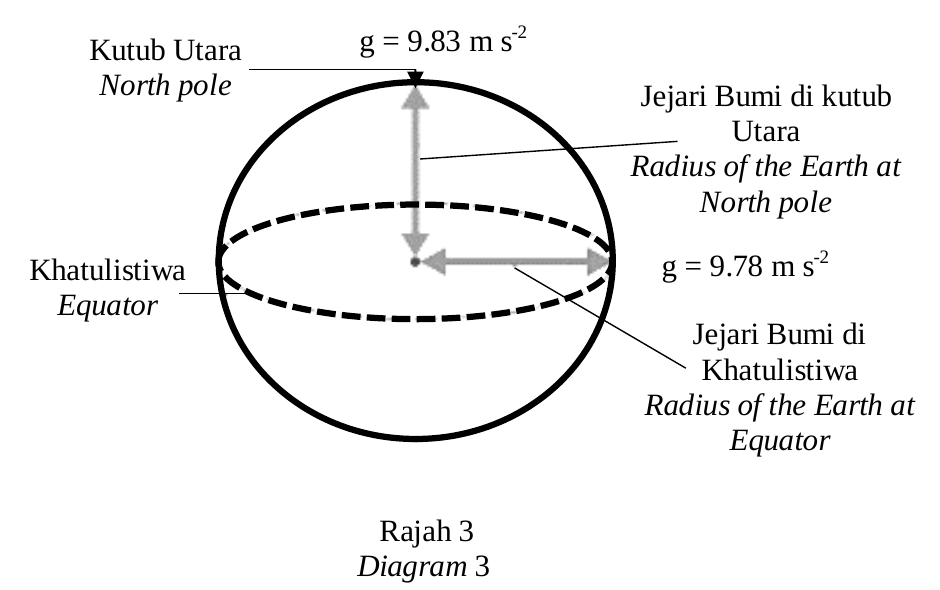
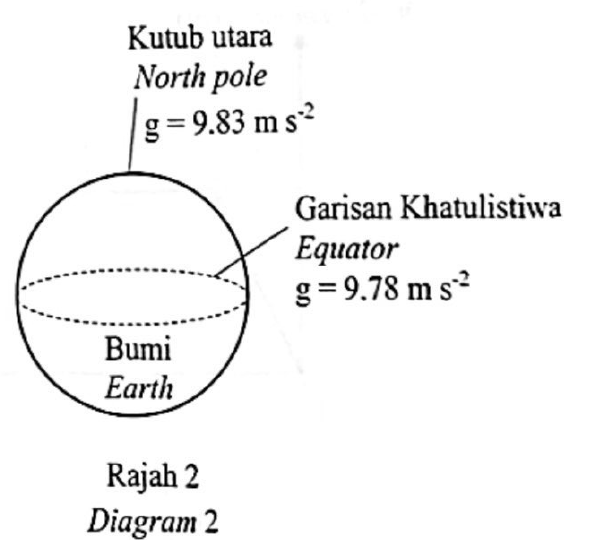
Diagram 3 shows the value of the acceleration of gravity at two different positions on the Earth's surface: g = 9.83 m s⁻² at the North pole and g = 9.78 m s⁻² at the Equator. Which of the following statements correctly describes the above situation?
Medium
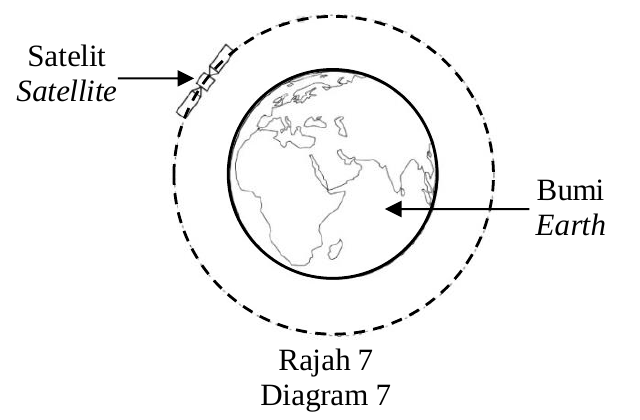
Diagram 7 shows a satellite orbiting the Earth with uniform speed. What force keeps the satellite in circular motion?
Medium
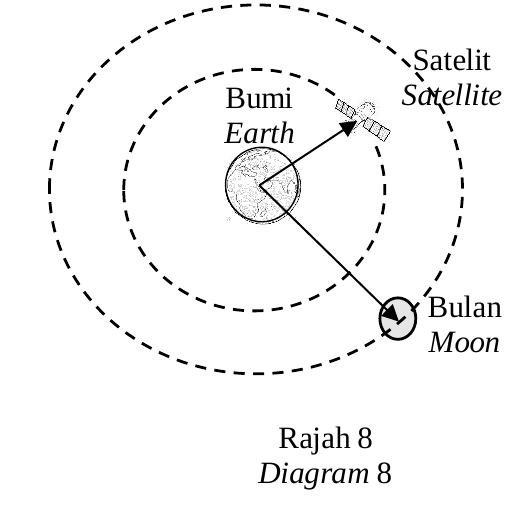
Diagram 8 shows a satellite and the Moon orbiting the Earth. What is the height of the satellite if the satellite is required to orbit the Earth with a period of 24 hours? [Orbital period of the Moon = 27.3 days, radius of orbit of the Moon = 3.83 x 10⁸ m, radius of the Earth, R = 6.37 x 10⁶ m]
Medium
A communication satellite can stay in its orbit and not escape into space. This is because the communication satellite
Easy
A spacecraft with mass 5 × 10⁵ kg is launched from Earth to the Moon. The mass of the earth and the moon are 6 × 10²⁴ kg and 7.4 × 10²² kg respectively. Calculate the gravitational force between the earth and the spacecraft when the distance of the spacecraft from the center of the earth is 1.6 × 10⁸ m.
Medium
Which of the following is not a factor that influences the gravitational acceleration?
Medium
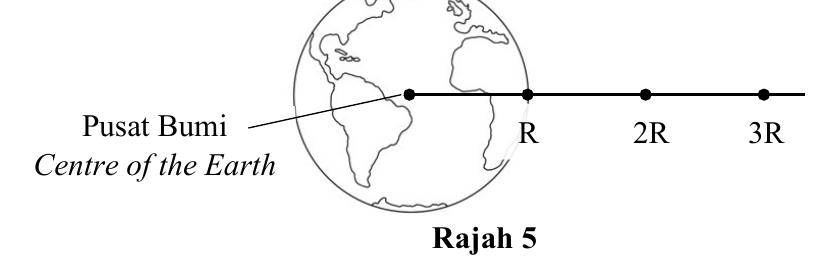
Diagram 5 shows distances measured from the centre of the Earth, where R is the radius of the Earth (marks at R, 2R, 3R). If r is any distance measured from the centre of the Earth and g is the Earth's gravitational acceleration, what is the relationship between g and r in the form of a graph?
Medium
Diagram 6 states a physics law: "All the planets move in elliptical orbits with the Sun positioned at one of the focal points." What law is explained by the above statement?
Easy
The orbital period of Earth is 1.0 year, while Jupiter's orbital period is 11.9 years. If the orbital radius of Earth is 1.5 × 10¹¹ m, calculate the orbital radius of Jupiter.
Medium
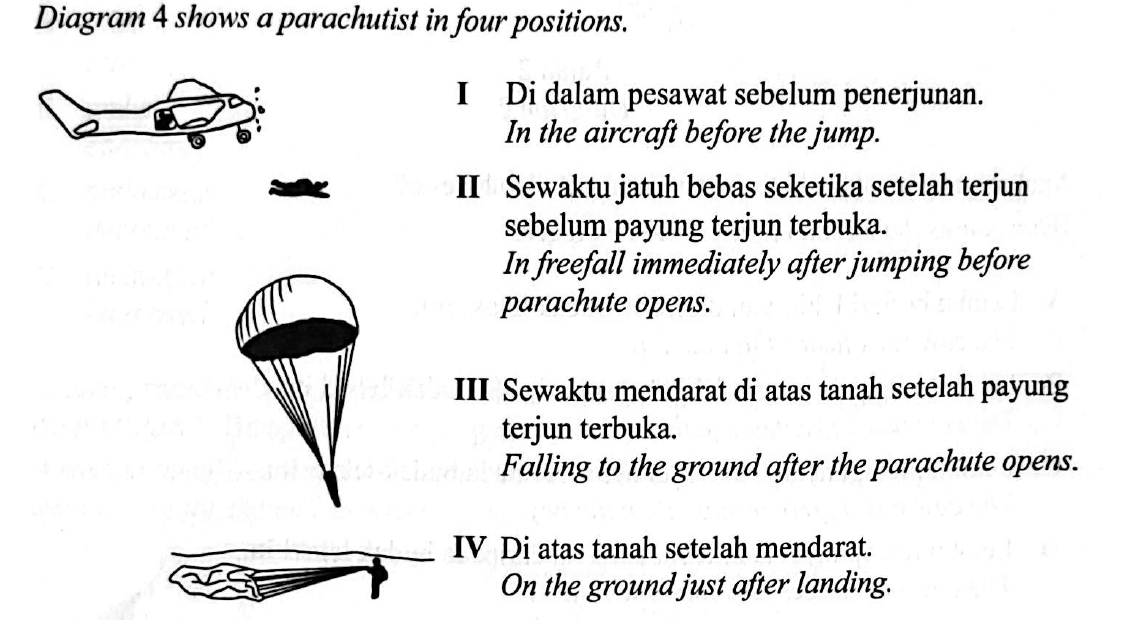
Diagram 4 shows a parachutist in four positions. I: In the aircraft before the jump. II: In freefall immediately after jumping before parachute opens. III: Falling to the ground after the parachute opens. IV: On the ground just after landing. Based on Newton’s Law of Universal Gravitation, at which position does the gravitational force act on the parachutist?
Medium
The following is a conversation between a teacher and a student during a Physics class. Student: Why does the Moon take shorter time to orbit the Earth than the Earth orbits the Sun? Teacher: This is because the radius of orbit of the Moon is smaller than the radius of orbit of the Earth. The larger the radius of an orbit, the longer the orbital period. Which law supports the teacher’s answer?
Medium
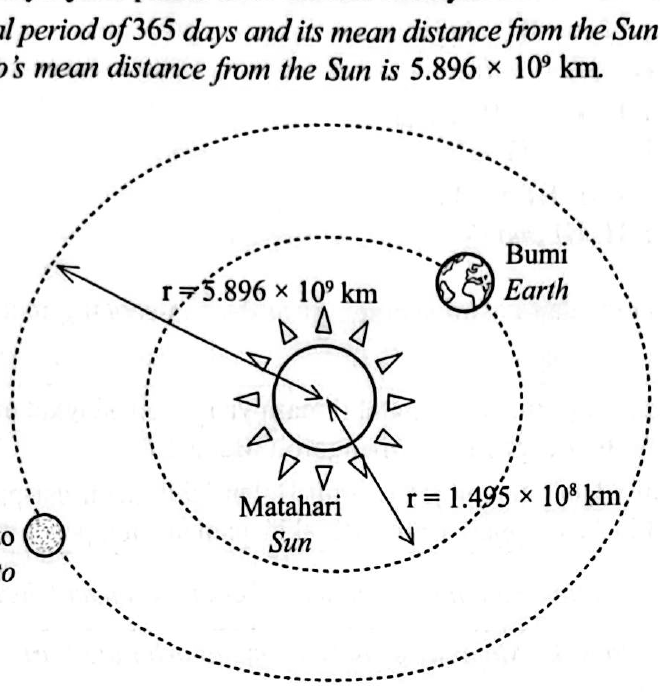
Earth has an orbital period of 365 days and its mean distance from the Sun is 1.495 × 10⁸ km. The planet Pluto’s mean distance from the Sun is 5.896 × 10⁹ km (Diagram 5). What is the Pluto’s orbital period?
Medium
Which of the following statement is correct about geostationary satellites?
Medium
A satellite is orbiting the Earth. The gravitational force acting on the satellite is FG and the centripetal force for keeping the satellite in orbit is FC. Which diagram shows the forces acting on the orbiting satellite?
Medium
What is the relationship between the orbital period of a planet, T, and the radius, r, of the planet around the Sun?
Easy
Which of the following statements about a geostationary satellite is true?
Medium
Diagram 3 shows the motion of a planet in its orbit (shaded sectors AFB and CFD about the central body F). Which of the following is correct?
Medium
The escape velocity of a rocket from the Earth does not depend on
Medium
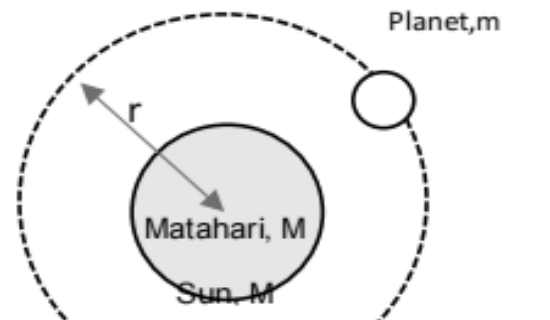
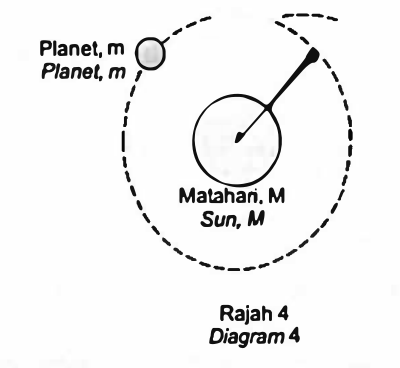
Diagram 4 shows a planet of mass m, moves in a circular orbit of radius r around the sun of mass M. The planet takes orbital period T to complete one revolution. Which of the following shows the correct relationship between T and m, M, r?
Medium
Diagram 5 shows the launch of a rocket into space. What is the minimum velocity required by the rocket to be launched into outer space? [Given that M = 5.97 × 10²⁴ kg, G = 6.67 × 10⁻¹¹ N m² kg⁻² and R = 6.37 × 10⁶ m]
Medium
A radar imaging satellite orbits around the earth at a height 500 km. What is the value of gravitational acceleration at the position of the satellite? [G = 6.67 × 10⁻¹¹ N m² kg⁻², R = 6.37 × 10⁶ m, M = 5.97 × 10²⁴ kg]
Medium
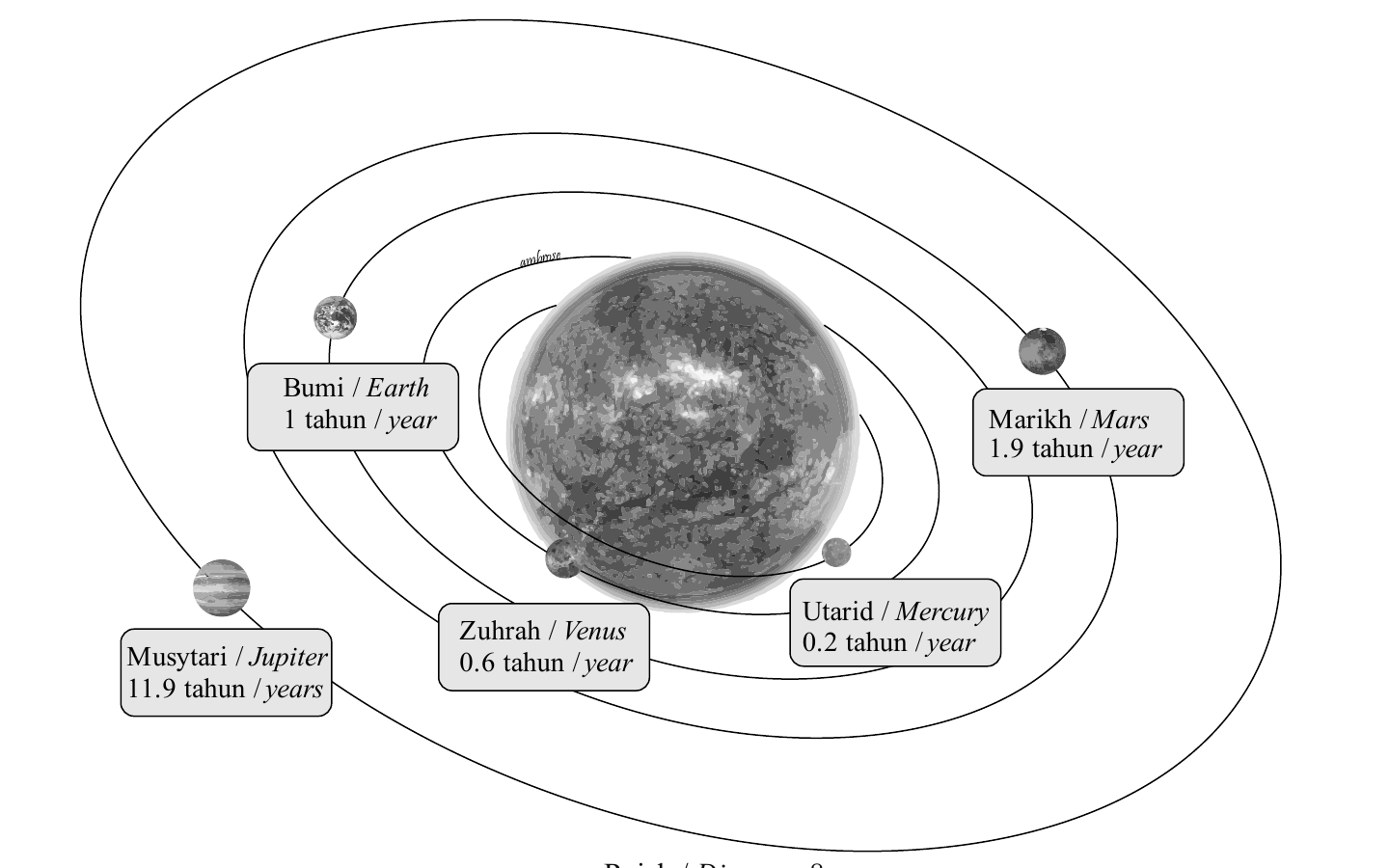
Diagram 8 shows some planets in solar system (Mercury 0.2 year, Venus 0.6 year, Earth 1 year, Mars 1.9 years, Jupiter 11.9 years). From Diagram 8, what is the conclusion can be made?
Medium
Which of the following statements are correct about geostationary satellite? I Orbital period is 24 hours. II Above the same geographical location. III Used in earth imaging, GPS and weather forecast. IV Direction of motion same as direction of earth rotation.
Medium
Diagram 2 shows the values of gravitational acceleration, g at the north pole (9.83 m s⁻²) and the Equator (9.78 m s⁻²) on the Earth's surface. Which statement is correct to describe the difference in the value of g?
Medium
State the definition of gravitational field strength.
Easy
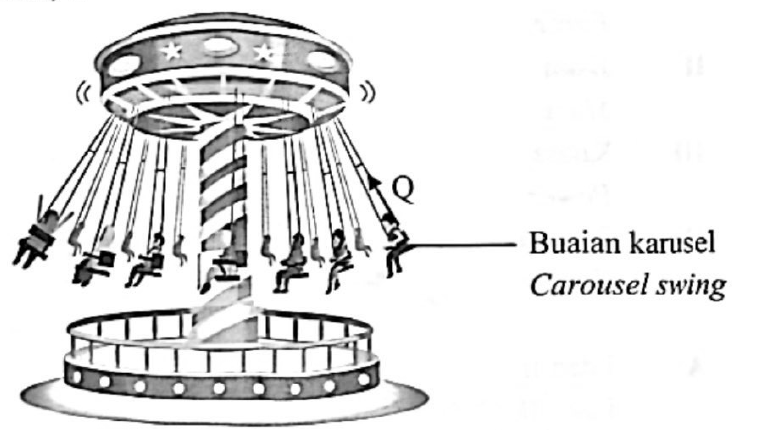
Diagram 6 shows a force Q acts on a carousel swing when the swing moves in a circular motion with a linear speed, v. What is force Q?
Easy
The orbital radius of Venus and Neptune orbiting the Sun are 1.082 × 10⁸ km and 4.497 × 10¹² m respectively. Given that the orbital period of Venus is 224.655 days. Calculate the orbital period of Neptune in the unit of days.
Medium
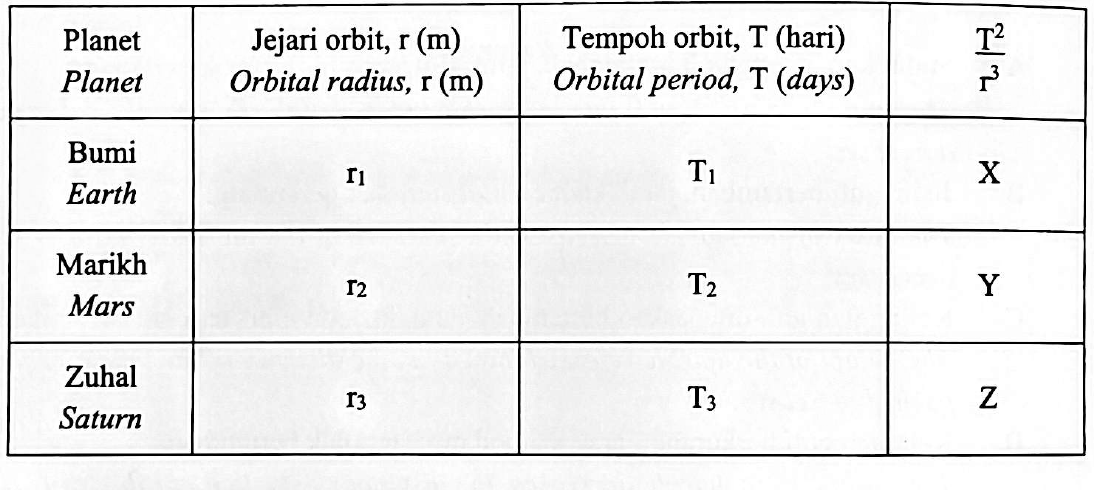
Table 1 shows the orbital radius, r and orbital period, T for the Earth, Mars and Saturn (columns: planet, orbital radius r (m) = r1, r2, r3; orbital period T (days) = T1, T2, T3; T²/r³ = X, Y, Z respectively). Which comparison is correct?
Medium
Which statement correctly describes a non-geostationary satellite?
Easy
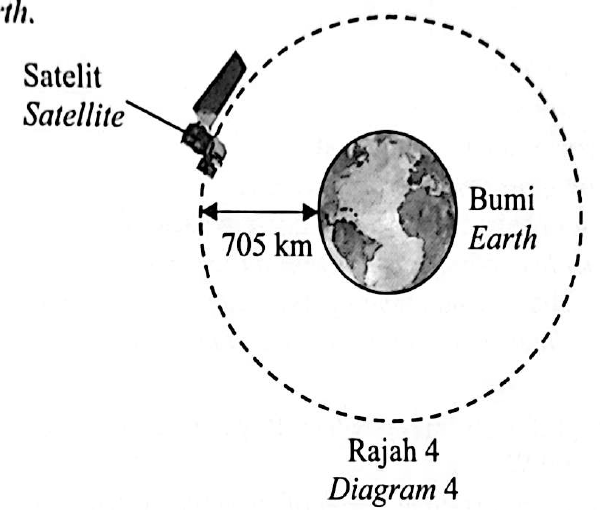
Diagram 4 shows a satellite of mass 2600 kg orbiting Earth at a distance 705 km from the surface of Earth. By using formula T² = 4π²r³/GM, calculate the orbital period of the satellite. [Mass of the Earth = 5.97 × 10²⁴ kg] [Radius of the Earth = 6.37 × 10³ km]
Medium
Which of the following is true about the satellites used in the Global Positioning System (GPS)?
Medium
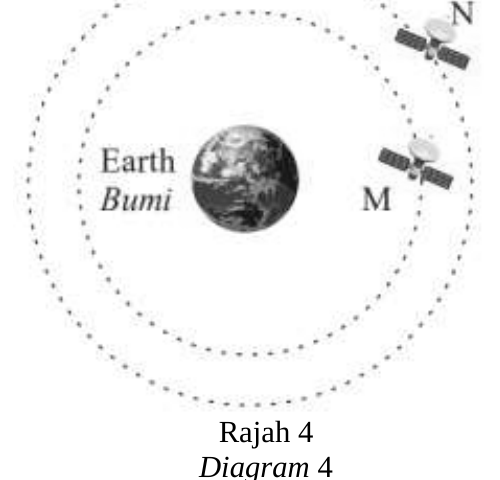
Diagram 4 shows two satellites, M and N, in different orbits around the Earth. The orbit of N is located further from the Earth than the orbit of M. Which of the following comparison is true?
Medium
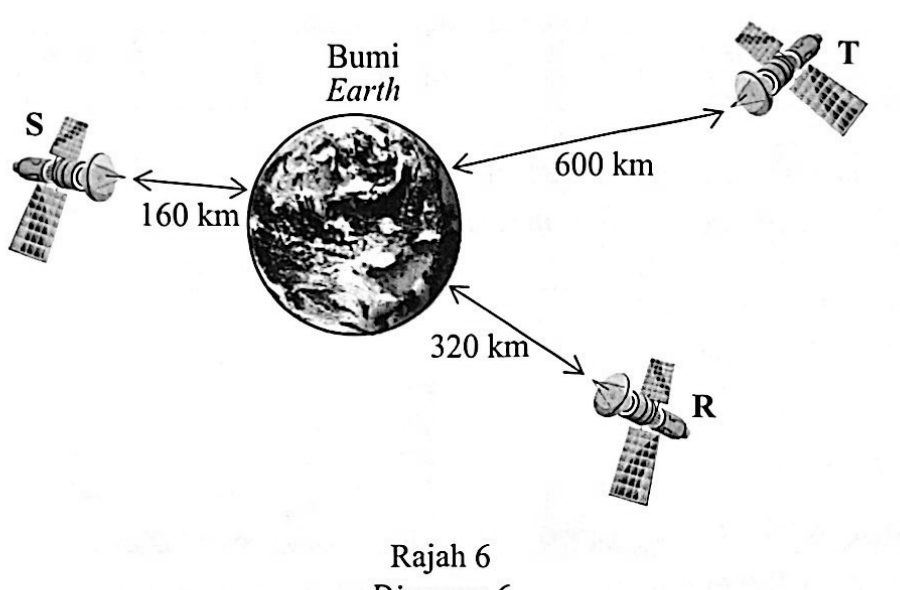
Diagram 6 shows 3 identical satellites, R, S and T located at different heights from the Earth's surface: S at 160 km, R at 320 km, T at 600 km. Which of the following shows the correct comparison of gravitational force and gravitational acceleration?
Medium
The following information is a statement of a Physics law: "All planets move in elliptical orbits with the Sun at one focus." Name the Physics law described by the statement.
Easy
What is the reason for the motion of the Moon on its orbit?
A The gravitational force exerted by the Sun.
B The gravitational force exerted by the Planets.
C The gravitational force exerted on the Earth by the Moon.
D The gravitational force exerted on the Moon by the Earth.
Easy
The period of a satellite in a circular orbit of radius R is T. The period of another satellite in circular orbit of radius 4R is
A 8T
B 2T
C ¼T
D ½T
Medium
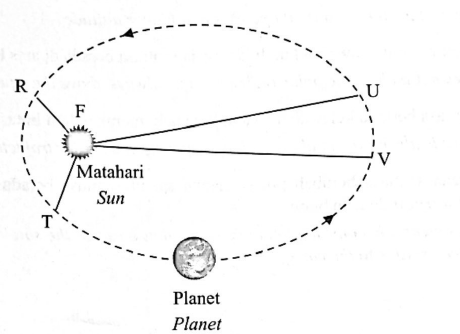
Diagram 3 shows a planet orbiting the Sun in an ellipse where the Sun is at one of the focus of the ellipse. The area of the FRT is equal to the area of the FUV. Based on Kepler's Second Law, deduce a relationship involving the time of the planet's motion from R to T and from V to U.
Medium
The disadvantages of geostationary satellites are as follows, except
Medium
Which graph shows the correct relationship between the gravitational force, F and the distance, r between the centre of mass of two bodies? (graphs of F against r²)
Medium
Which of the following statements does not explain Newton’s Universal Law of Gravitation?
Medium
Satellite M is 4 times far from the centre of the Earth than satellite N. Satellite M takes 20 weeks to orbit the Earth. How long does it take satellite N to orbit the Earth?
Medium
Which of the following physical quantities can affect the escape velocity of a spacecraft from Earth?
Medium
Which of the following graphs shows the change in acceleration due to the Earth's gravity, g', with the distance from the Earth's centre, r, where g is the gravitational acceleration at the Earth's surface?
Medium
Satellite M is 4 times farther from the planet than satellite N. When satellite M takes 20 weeks to orbit the planet, how long does it take for satellite N to orbit the planet?
Medium
The escape velocity of the Earth is 11.2 km s⁻¹. Another planet has a mass 500 times the mass of the Earth and a radius 20 times the radius of the Earth. What is the escape velocity from the planet?
Medium
Which graph shows the correct relationship between the gravitational force, F and the distance, r between the center of mass of two bodies?
Medium
The information below states one law: "All planets move in elliptical orbits with the Sun at one focus." What law is explained by the above statement?
Easy
What factors affect the escape velocity of an object from the surface of a planet?
Medium
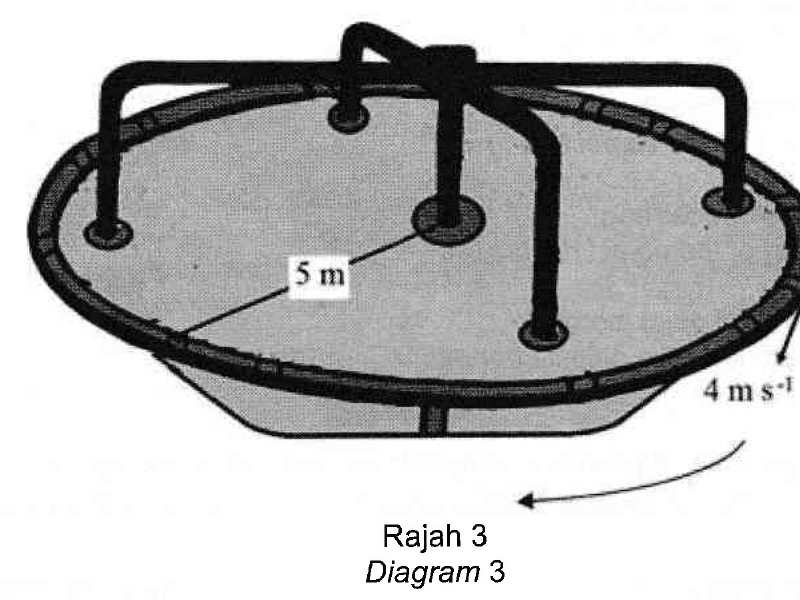
Diagram 3 shows a playground equipment with a radius of 5 m and rotating with a linear speed of 4 m s⁻¹. What is the centripetal acceleration of the toy?
Medium
Diagram 4 shows a planet orbiting the sun in an ellipse with the sun being the focus. Which of the following statements explains about Kepler's law involved and the time the planet moves?
Medium
Which of the following statements is true about geostationary satellite?
Medium
Which of the following statements is correct about Newton's Law of Universal Gravitation?
Easy
Diagram 4 shows a planet of mass, m, moves in a circular orbit of radius, r, around the sun of mass, M. The planet takes an orbital period, T, to complete one revolution. Which of the following shows the correct relationship between T, m, M and r?
Medium
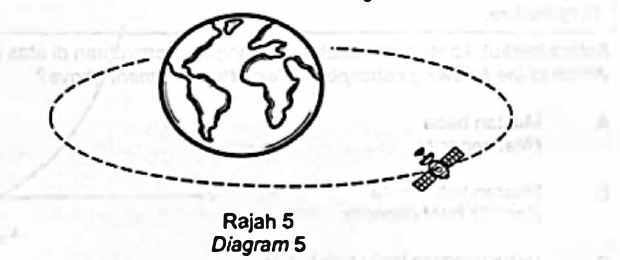
Diagram 5 shows a communication satellite orbiting the Earth. What is the period of the satellite orbiting the Earth?