SPM Tuition
Subject
Request Tuition

FORM 4

01Introduction to Chemistry
02Matter and the Atomic Structure2.1 Basic Concepts of Matter0/52.2 The Development of the Atomic Model0/32.3 Atomic Structure0/42.4 Isotopes and Its Uses0/3Topical past papers0/244
03The Mole Concept, Chemical Formula and Equation
04The Periodic Table of Elements
05Chemical Bond
06Acid, Base and Salt
07Rate of Reaction
08Manufactured Substances in Industry

FORM 5

01Redox Equilibrium
02Carbon Compound
03Thermochemistry
04Polymer
05Consumer and Industrial Chemistry
Past papers
  1. Chemistry
  2. Chapter 2 Matter and the Atomic Structure
  3. 2.3 Atomic Structure
  4. Electron arrangement

2.3 Atomic Structure: Electron arrangement

  1. Subatomic particles
  2. Electron arrangement
  3. Nuclide symbols
  4. Practice

Electron arrangement

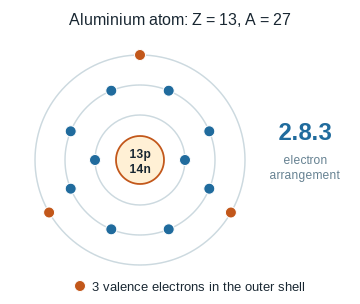
An aluminium atom with 13 protons and 14 neutrons in the nucleus, and 13 electrons in shells of 2, 8 and 3. The 3 outer electrons are the valence electrons.
Worked example

Find the particles and electron arrangement of a neutral atom with Z = 13 and A = 27.

0 / 3 steps
Exam tip: An ion forms by changing electrons, not the proton number. Valence electrons occupy the outermost shell.