SPM Tuition
Subject
Request Tuition

FORM 4

01Introduction to Chemistry
02Matter and the Atomic Structure
03The Mole Concept, Chemical Formula and Equation3.1 Relative Atomic Mass and Relative Molecular Mass0/33.2 Mole Concept0/43.3 Chemical Formula0/43.4 Chemical Equation0/4Topical past papers0/338
04The Periodic Table of Elements
05Chemical Bond
06Acid, Base and Salt
07Rate of Reaction
08Manufactured Substances in Industry

FORM 5

01Redox Equilibrium
02Carbon Compound
03Thermochemistry
04Polymer
05Consumer and Industrial Chemistry
Past papers
  1. Chemistry
  2. Chapter 3 The Mole Concept, Chemical Formula and Equation
  3. 3.4 Chemical Equation
  4. Stoichiometry

3.4 Chemical Equation: Stoichiometry

  1. Conserving atoms
  2. Stoichiometry
  3. Limiting reactants
  4. Practice

Stoichiometry

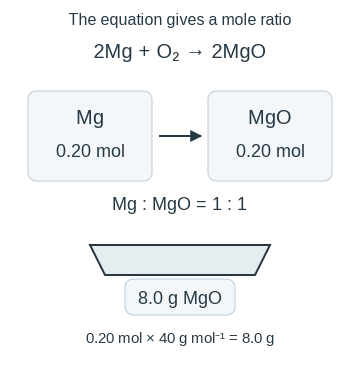
The equation gives a 1:1 mole ratio between magnesium and magnesium oxide. 0.20 mol MgO has mass 8.0 g.
Use the mole ratio before converting to mass.
Worked example

How much MgO forms from 0.20 mol Mg in excess oxygen? M(MgO) = 40 g mol⁻¹.

0 / 3 steps
Exam tip: Convert the given mass to moles before using the coefficient ratio. Coefficients are not mass ratios.