SPM Tuition
Subject
Request Tuition

FORM 4

01Introduction to Chemistry
02Matter and the Atomic Structure
03The Mole Concept, Chemical Formula and Equation
04The Periodic Table of Elements4.1 The Development of the Periodic Table of Elements0/34.2 The Arrangement in the Periodic Table of Elements0/34.3 Elements in Group 180/34.4 Elements in Group 10/34.5 Elements in Group 170/34.6 Elements in Period 30/34.7 Transition Elements0/3Topical past papers0/282
05Chemical Bond
06Acid, Base and Salt
07Rate of Reaction
08Manufactured Substances in Industry

FORM 5

01Redox Equilibrium
02Carbon Compound
03Thermochemistry
04Polymer
05Consumer and Industrial Chemistry
Past papers
  1. Chemistry
  2. Chapter 4 The Periodic Table of Elements
  3. 4.4 Elements in Group 1
  4. Reactions

4.4 Elements in Group 1: Reactions

  1. Electron loss and trends
  2. Reactions
  3. Practice

Reactions

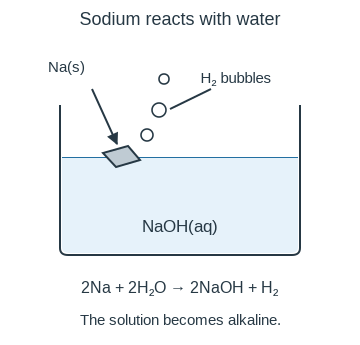
Sodium floats on water and releases hydrogen bubbles. Sodium hydroxide forms in the solution.
Locate the hydrogen gas and sodium hydroxide.
ReactantProduct pattern
WaterMetal hydroxide + hydrogen
OxygenMetal oxide in the simplified syllabus reaction
ChlorineMetal chloride

2Na + 2H₂O → 2NaOH + H₂. The solution becomes alkaline.

Exam tip: A more reactive metal loses its outer electron more easily. Do not describe it as attracting electrons more strongly.