SPM Tuition
Subject
Request Tuition

FORM 4

01Introduction to Chemistry
02Matter and the Atomic Structure
03The Mole Concept, Chemical Formula and Equation
04The Periodic Table of Elements
05Chemical Bond
06Acid, Base and Salt6.1 The Role of Water in Showing Acidic and Alkaline Properties0/36.2 pH Value0/36.3 Strength of Acids and Alkalis0/36.4 Chemical Properties of Acids and Alkalis0/36.5 Concentration of Aqueous Solution0/36.6 Standard Solution0/46.7 Neutralisation0/46.8 Salts, Crystals and Their Uses in Daily Life0/36.9 Preparation of Salts0/36.10 Effect of Heat on Salts0/36.11 Qualitative Analysis0/4Topical past papers0/446
07Rate of Reaction
08Manufactured Substances in Industry

FORM 5

01Redox Equilibrium
02Carbon Compound
03Thermochemistry
04Polymer
05Consumer and Industrial Chemistry
Past papers
  1. Chemistry
  2. Chapter 6 Acid, Base and Salt
  3. 6.2 pH Value
  4. The pH scale

6.2 pH Value: The pH scale

  1. The pH scale
  2. Calculating and diluting
  3. Practice

The pH scale

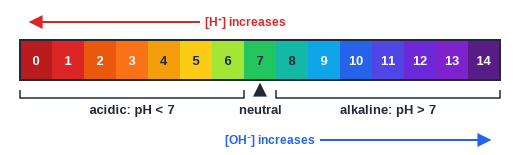
At 25 °CpHIon comparison
AcidicBelow 7[H⁺] > [OH⁻]
Neutral7[H⁺] = [OH⁻]
AlkalineAbove 7[OH⁻] > [H⁺]
The pH scale from 0 to 14 in universal indicator colours. pH below 7 is acidic, 7 is neutral and above 7 is alkaline. H⁺ concentration increases towards 0. OH⁻ concentration increases towards 14.
pH scale with universal indicator colours

pH = −log₁₀[H⁺], with concentration in mol dm⁻³. At 25 °C, pH + pOH = 14.