SPM Tuition
Subject
Request Tuition

FORM 4

01Introduction to Chemistry
02Matter and the Atomic Structure
03The Mole Concept, Chemical Formula and Equation
04The Periodic Table of Elements
05Chemical Bond
06Acid, Base and Salt6.1 The Role of Water in Showing Acidic and Alkaline Properties0/36.2 pH Value0/36.3 Strength of Acids and Alkalis0/36.4 Chemical Properties of Acids and Alkalis0/36.5 Concentration of Aqueous Solution0/36.6 Standard Solution0/46.7 Neutralisation0/46.8 Salts, Crystals and Their Uses in Daily Life0/36.9 Preparation of Salts0/36.10 Effect of Heat on Salts0/36.11 Qualitative Analysis0/4Topical past papers0/446
07Rate of Reaction
08Manufactured Substances in Industry

FORM 5

01Redox Equilibrium
02Carbon Compound
03Thermochemistry
04Polymer
05Consumer and Industrial Chemistry
Past papers
  1. Chemistry
  2. Chapter 6 Acid, Base and Salt
  3. 6.5 Concentration of Aqueous Solution
  4. Two concentration measures

6.5 Concentration of Aqueous Solution: Two concentration measures

  1. Two concentration measures
  2. Calculation
  3. Practice

Two concentration measures

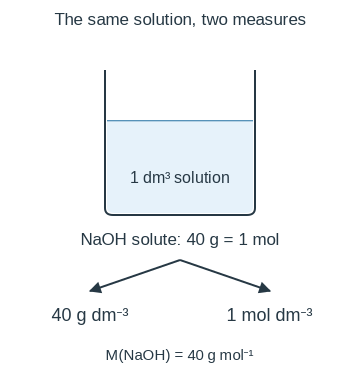
One dm³ of solution contains 40 g, or one mole, of NaOH. Its concentrations are 40 g dm⁻³ and 1 mol dm⁻³.
Express one solution by solute mass or amount.
MeasureFormulaUnit
Mass concentrationMass of solute ÷ solution volumeg dm⁻³
Molar concentration, cAmount of solute ÷ solution volumemol dm⁻³

c = n ÷ V. Use V in dm³. Mass concentration = c × molar mass.