1.4 Electrolytic cell: Writing aqueous half-equations
Writing aqueous half-equations
| Change | Half-equation |
|---|---|
| Hydrogen from water | 2H₂O + 2e⁻ → H₂ + 2OH⁻ |
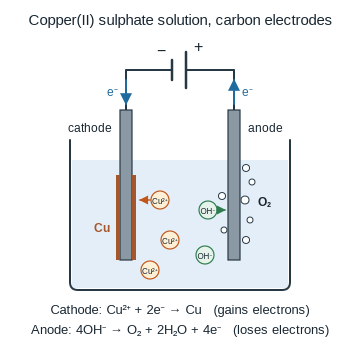
| Oxygen from hydroxide | 4OH⁻ → O₂ + 2H₂O + 4e⁻ |
| Chlorine from chloride | 2Cl⁻ → Cl₂ + 2e⁻ |
| Copper deposition | Cu²⁺ + 2e⁻ → Cu |
At an inert cathode, less reactive metal ions such as Cu²⁺ are discharged instead of hydrogen.
Highly reactive metal ions such as Na⁺ remain in aqueous solution while hydrogen forms.
Concentrated halide solutions can favour halogen discharge at inert anodes. Sulphate and nitrate usually remain unchanged.