Converting motion graphs
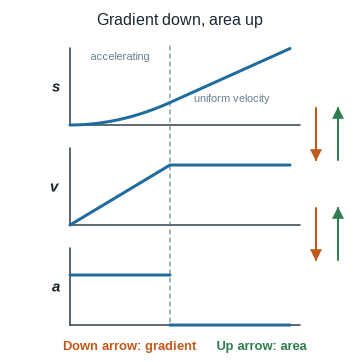 Each change in motion happens at the same time on every graph.
| Start with | Find | Draw |
|---|
| Displacement–time graph | Gradient in each interval | Velocity–time graph |
| Velocity–time graph | Gradient in each interval | Acceleration–time graph |
| Acceleration–time graph | Signed area; add initial velocity | Velocity–time graph |
| Velocity–time graph | Signed area; add initial displacement | Displacement–time graph |
| Motion | Displacement–time shape | Velocity–time shape | Acceleration–time shape |
|---|
| At rest | Horizontal | On time axis | On time axis |
| Uniform positive velocity | Straight rising line | Horizontal above axis | On time axis |
| Uniform positive acceleration from rest | Curve becomes steeper | Straight rising line from origin | Horizontal above axis |
| Uniform deceleration while moving positively | Rising curve becomes flatter | Straight falling line towards axis | Horizontal below axis |
Exam tip: Keep the same time intervals on every graph. A change in motion must appear at the same time.