2.4 Inertia: The inertial balance experiment
The inertial balance experiment
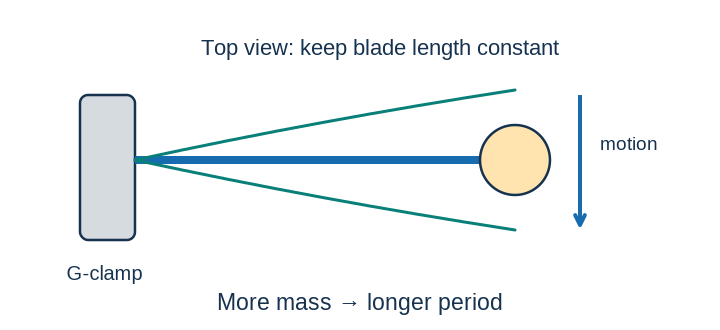
| Variable | Quantity |
|---|---|
| Manipulated | Mass of plasticine, m |
| Responding | Period of oscillation, T |
| Constant | Distance between the G-clamp and plasticine |
Attach a known mass of plasticine
Displace the free end horizontally
Time ten complete oscillations
Repeat the timing
Calculate the average period
Repeat with larger masses
T = average time for ten oscillations ÷ 10. Plot a graph of T² against m.
Understand, don’t memorise: A larger mass gives a longer period. This shows greater inertia.
Example — period
Ten oscillations take 12.0 s and 12.4 s in two trials. Find the average period.
0 / 3 steps
Exam tip: Time complete oscillations from the same position and direction. Keep the free blade length unchanged.