3.3 Man-made Satellites: Satellite orbits
Satellite orbits
| Quantity or condition | Relationship or meaning |
|---|---|
| Circular orbital speed | v = √(GM ÷ r), where r = R + h |
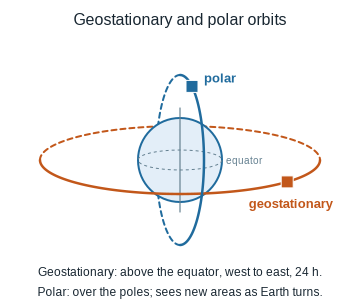
| Geostationary satellite | Equatorial orbit; west to east; period about 24 hours |
| Non-geostationary satellite | Changes position relative to a point on Earth |
| Escape velocity | v = √(2GM ÷ R) at the surface |
A geostationary satellite remains above the same point on the equator. It supports fixed communication dishes.
Polar satellites scan different areas as Earth rotates. They support mapping and weather observations.
Exam tip: A satellite remains under gravity. Orbiting is continuous free fall, not an absence of gravity.