SPM Tuition
Subject
Request Tuition

FORM 4

01Introduction to Chemistry
02Matter and the Atomic Structure
03The Mole Concept, Chemical Formula and Equation
04The Periodic Table of Elements
05Chemical Bond5.1 Basics of Compound Formation0/35.2 Ionic Bond0/35.3 Covalent Bond0/35.4 Hydrogen Bond0/35.5 Dative Bond0/35.6 Metallic Bond0/35.7 Properties of Ionic Compounds and Covalent Compounds0/3Topical past papers0/285
06Acid, Base and Salt
07Rate of Reaction
08Manufactured Substances in Industry

FORM 5

01Redox Equilibrium
02Carbon Compound
03Thermochemistry
04Polymer
05Consumer and Industrial Chemistry
Past papers
  1. Chemistry
  2. Chapter 5 Chemical Bond
  3. 5.1 Basics of Compound Formation
  4. Choosing a bond model

5.1 Basics of Compound Formation: Choosing a bond model

  1. Stable arrangements
  2. Choosing a bond model
  3. Practice

Choosing a bond model

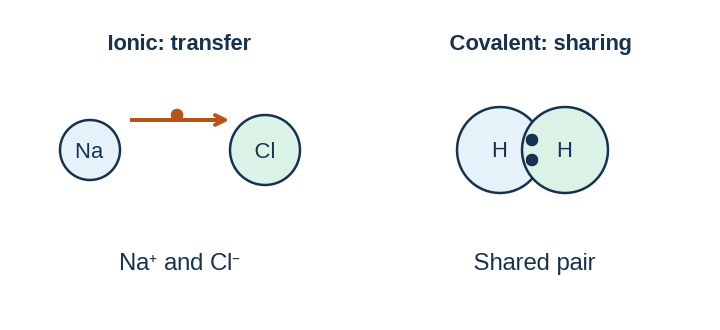
Electron transfer and electron sharing are different bond models

A metal with a non-metal commonly forms an ionic compound. Non-metal atoms commonly form covalent bonds.

Exam tip: Bonding changes electrons. The nuclei retain their proton numbers.