SPM Tuition
Subject
Request Tuition

FORM 4

01Introduction to Chemistry
02Matter and the Atomic Structure
03The Mole Concept, Chemical Formula and Equation
04The Periodic Table of Elements
05Chemical Bond5.1 Basics of Compound Formation0/35.2 Ionic Bond0/35.3 Covalent Bond0/35.4 Hydrogen Bond0/35.5 Dative Bond0/35.6 Metallic Bond0/35.7 Properties of Ionic Compounds and Covalent Compounds0/3Topical past papers0/285
06Acid, Base and Salt
07Rate of Reaction
08Manufactured Substances in Industry

FORM 5

01Redox Equilibrium
02Carbon Compound
03Thermochemistry
04Polymer
05Consumer and Industrial Chemistry
Past papers
  1. Chemistry
  2. Chapter 5 Chemical Bond
  3. 5.1 Basics of Compound Formation
  4. Stable arrangements

5.1 Basics of Compound Formation: Stable arrangements

  1. Stable arrangements
  2. Choosing a bond model
  3. Practice

Stable arrangements

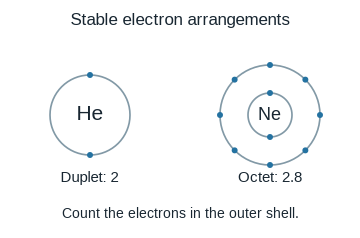
Helium has a duplet. Neon has an octet in its outer shell.
Count the electrons in each outer shell.

Atoms form bonds through valence electrons. Bond formation can produce stable duplet or octet electron arrangements.

BondElectron change
IonicElectrons transfer between atoms; opposite ions attract.
CovalentAtoms share electron pairs.